
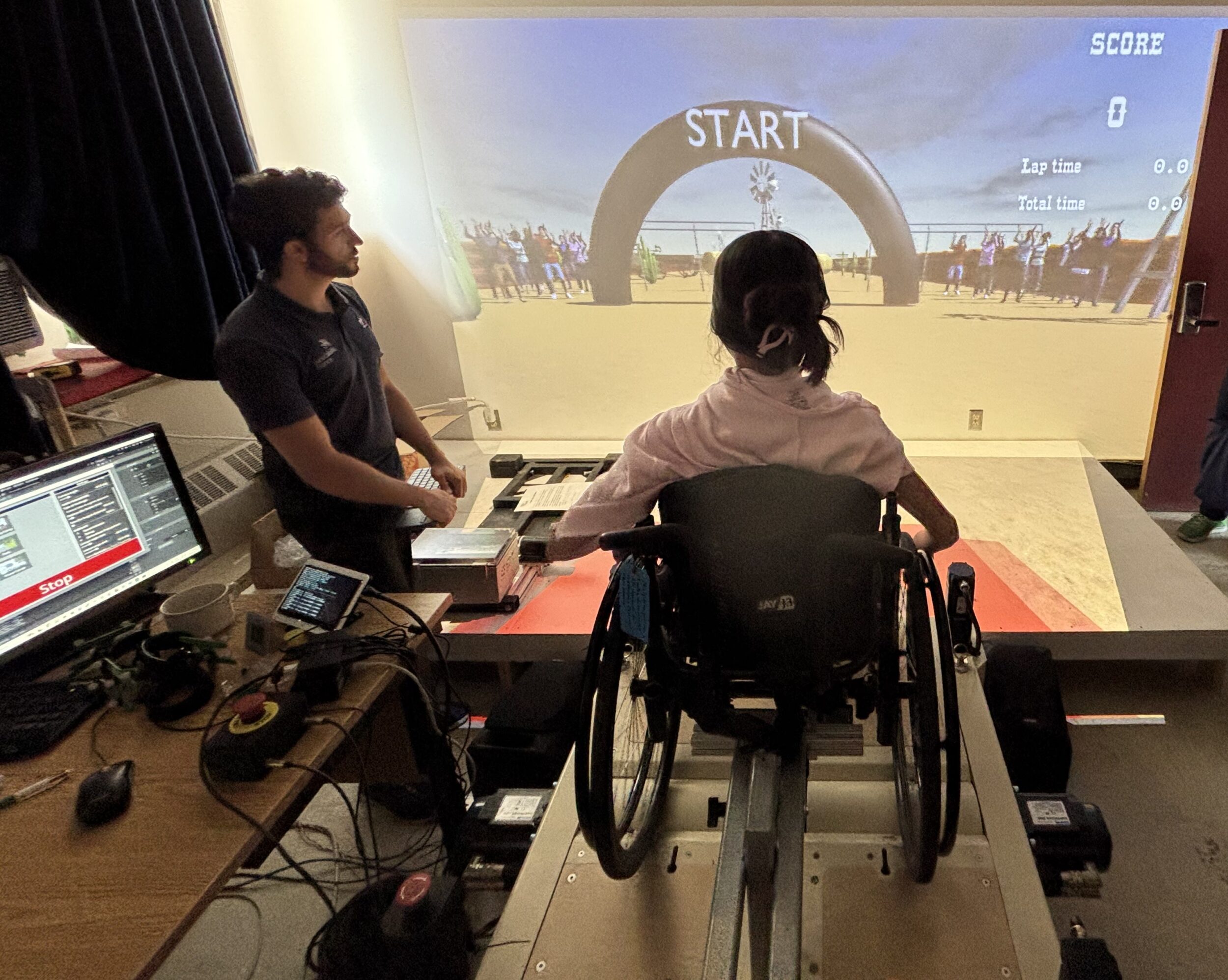
Following an accident or illness, some people have to relearn how to get around in a wheelchair. Although they receive brief training on how to manoeuvre their wheelchairs, they have little time with healthcare professionals to practise and develop safe propulsion techniques. This stage is, however, crucial, as wheelchair users are at a high risk of shoulder injuries.
Félix Chénier, a Researcher at the Centre for Interdisciplinary Research in Rehabilitation of Greater Montreal (CRIR) and the University Institute on Physical Rehabilitation of Montreal (IURDPM), and Full Professor in the Department of Physical Activity Sciences at the Université du Québec à Montréal (UQAM)., has long been interested in the biomechanics of wheelchair propulsion. Together with his team, he has developed a high-realism simulator designed to teach safe propulsion techniques in order to reduce the risk of musculoskeletal shoulder injuries.
The wheelchair propulsion simulator developed by the research team accurately replicates the conditions encountered by wheelchair users in their daily lives. Motorized rollers and force sensors recreate the effort required to move forward on different surfaces, such as grass or carpet. A robotic platform also replicates the inclines of slopes and pavements, while an immersive visual environment is projected onto a large screen with the image extending down to the floor, immersing the user in realistic scenarios.
Beyond training, the simulator serves as an actual research laboratory. The integration of advanced biomechanical models enables precise analysis of body movements and the stresses placed on the upper limbs when propelling the wheelchair, thereby identifying the safest techniques for the shoulders.
Development of the simulator’s key components is now sufficiently advanced to transition to clinical research. The next steps will focus on assessing its feasibility in a clinical setting and designing muscle and cardiorespiratory training programs for users. Thanks to its open architecture, the system can also be adopted and adapted by other research teams, promoting the development of new approaches to improve wheelchair propulsion training and prevent musculoskeletal injuries in wheelchair users.
Références
Chénier, F., Moison, J., Perrudin, B., El Abdouli, M., Ghazouani, C. et Aissaoui, R. (2026). Characterizing wheelchair vibrations to enhance self-motion perception in wheelchair simulators. World Congress of Biomechanics, Vancouver, Canada.
Bayat, A. et Chénier, F. (2026). Effect of simulator rolling resistance compensation on manual wheelchair propulsion biomechanics. World Congress of Biomechanics, Vancouver, Canada.
Pizarro-Chong, A. et Chénier, F. (2021, mai). Development and validation of the control loop of the haptic interfaces for a manual wheelchair propulsion simulator. 21st Biennial Meeting of the Canadian Society for Biomechanics.

Marine Microbes: The Unsung Heroes of the Carbon Cycle

